

Assisted Suicide
Maryland Right to Life is concerned with the protection of human life from the moment of conception onward. Maryland Right to Life strongly opposes assisted suicide and euthanasia.
As states have legalized assisted suicide, more and more people have been abandoned to death. In 1994, Oregon became the first state to legalize assisted suicide. Since then, thirteen states (13) and the District of Columbia have passed similar laws which have put some our society’s most vulnerable members at risk.
When it comes to assisted suicide, there is no realistic way to prevent coercion, abuse, or mistakes. So-called “safeguards” do not work. The “safeguards” touted by assisted suicide proponents are insufficient without enforcement and investigative authority. And even then, as we have seen in other states, “safeguards” can be removed later through legal challenge or further legislative action.

NEW Maryland Right to Life Brochure: The Reality of Assisted Suicide (PDF)
Resources
Euthanasia Fact Sheets – National Right to Life
8 Reasons to Oppose Assisted Suicide (PDF)
Assisted Suicide Abuses Hurt Patients (PDF)
“When They Say…You Say” – Arguments Against Assisted Suicide (PDF)
Assisted suicide represents a grave threat to elder persons, the medically vulnerable, people living with disabilities, and others whose lives may be undervalued by society or deemed “inconvenient” or “too expensive.”
Assisted suicide and our profit-driven healthcare system is a deadly mix. Economic incentives threaten to deprive patients of life-saving treatment because provision of lethal drugs is cheaper. Financial pressure quickly transforms a “decision to die” into a “duty to die” for low-income individuals or people on fixed incomes.
Vulnerable patients deserve protection and care, not pressure to die.
Factsheet: Unintended and Dangerous Consequences of Assisted Suicide (PDF)
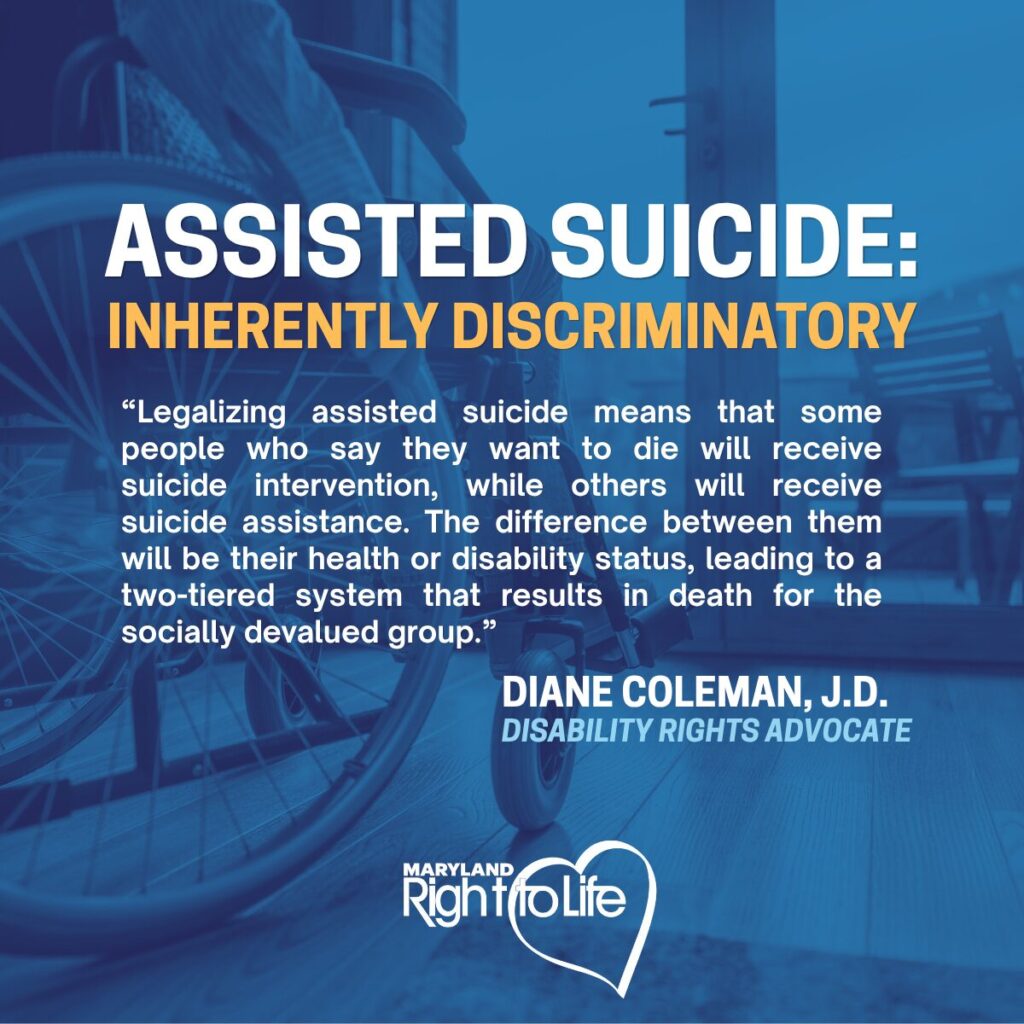
Maryland Right to Life on Substack: Assisted Suicide: Wrong for Maryland
Assisted Suicide Statute: Fatally Flawed, Dangerous for Maryland Patients
“What’s Wrong With Making Assisted Suicide Legal?“ – By: Burke Balch, J.D. & David N. O’Steen, Ph.D.
National Right to Life: “States Allowing Assisted Suicide“ Factsheet (PDF)

Opposition to Assisted Suicide Among Medical Professionals
The American Medical Association (AMA), the nation’s largest professional association for physicians and medical students, opposes legalizing assisted suicide. Many physicians view assisted suicide as one of the biggest threats to authentic medicine.
The AMA Code of Medical Ethics states, “Physician-assisted suicide is fundamentally incompatible with the physician’s role as healer, would be difficult or impossible to control, and would pose serious societal risks.”

Diverse Allies Unite Against Assisted Suicide
Opponents of assisted suicide range the political spectrum, but we come together to oppose this dangerous public policy. Assisted suicide raises concerns among progressives and conservatives, Democrats and Republicans, and everyone in between.
Maryland Right to Life partners with medical professionals, disability rights activists, veterans groups, faith leaders and congregations, members of marginalized communities, elder advocates, pro-life groups, and others to raise awareness about the dangers of assisted suicide.
Members of the disability rights community are some of the most vocal opponents of assisted suicide.
National Council on Disability: The Danger of Assisted Suicide Laws (PDF) – “The risks of abuse are significant under assisted suicide laws and safeguards are not effective.”
It is important to use language that affirms the dignity of every human person. When speaking to or about people living with disabilities, we should be mindful that the words we choose can either uphold that dignity or unintentionally diminish it, even when no offense is intended.
(Pictured): Melissa Ortiz, disability rights advocate and founder of Capability Consulting, speaks out against the prospect of assisted suicide in Maryland at the Maryland Right to Life Convention (May 16, 2026).
Advance Directives
Do you have a Will to Live (Pro-Life Advance Directive)?
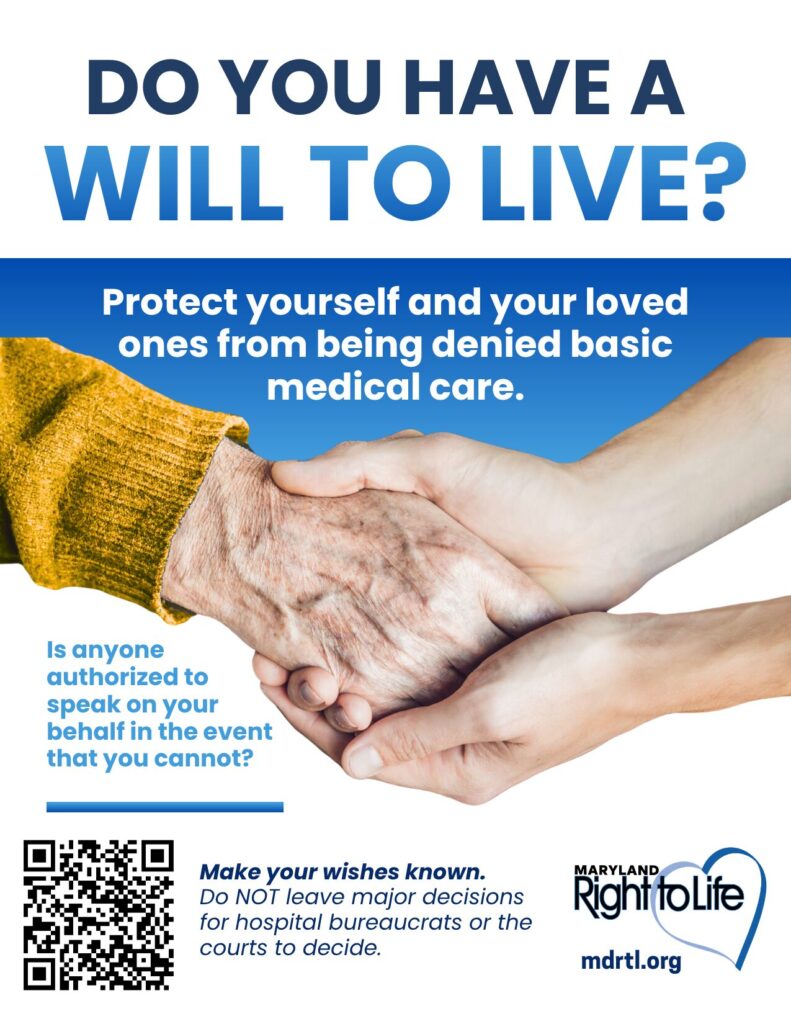
A Will to Live names someone you trust to make health care decisions for you if you develop a condition that renders you incapable of speaking for yourself. It also clarifies what types of medical treatment you would want, including food & fluids.
Without a Will to Live, you and your loved ones may be at the mercy of hospital administrators or the courts, which may be motivated by cutting costs and may not share your values.
A Will to Live is a legally binding pro-life alternative to traditional living wills. If you’re someone who doesn’t want medical technology to prolong your last hours, but who also doesn’t want to be starved or allowed to die just because you have a disability, your wishes are far more likely to be respected if you sign a properly prepared Will to Live versus a living will.
Protect yourself and your loved ones from involuntary denial of medical treatment. A Will to Live empowers your loved ones to push back on pressure by health care providers or others to withdraw basic food and fluids.
Report from the Robert Powell Center for Medical Ethics: Will Your Advance Directive Be Followed?
Additional Resources on Assisted Suicide and Euthanasia:
The Euthanasia Prevention Coalition
The Terri Schiavo Life and Hope Network
National Crisis Lifeline: Every day, patients and their families face heartbreaking situations where their basic human dignity is at risk – not because of their own choices, but because a physician, hospital, or insurance company holds a different view about the care they deserve. In the most tragic cases, this can mean being denied even the most basic necessities of life, like food and water, through the forcible removal of a feeding tube. If you or a family member are at-risk, contact: 1 (855) 300-HOPE (4673) or email lifeline@lifeandhope.com.
Want to support Maryland Right to Life’s ongoing work to educate the public about assisted suicide and euthanasia? Consider making an online donation today to support our efforts! Donate